2. TURKISH RUGS -- page 2 of 21
2. Turkish Pile Rugs: the Collection of Dennis Dodds and Zinaida Vaganova
BELOW: Central Anatolia, Karapinar region, c. 1800-50. A classic Holbein type with two large connected octagons. SOLD
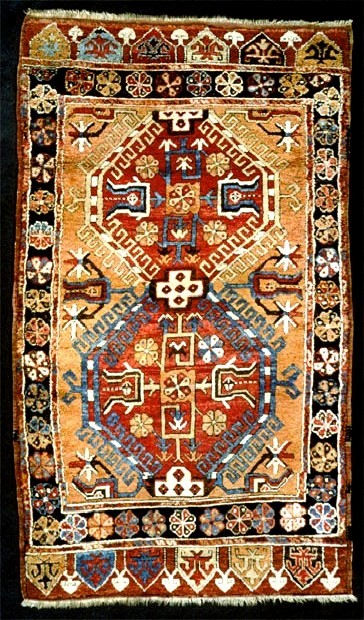
BELOW: Central Anatolia, Konya-Cappadocia long rug, 1800-1850 SOLD
The distinctive palette with a preponderance of pale yellow is rare and may suggest a weaving center in the Cappadocia region. Note the retention of 15th c. Ottoman devices of tulips, carnations and hyacinths. The pattern is woven in the rare 'kilim style' with no outlines between the design elements.
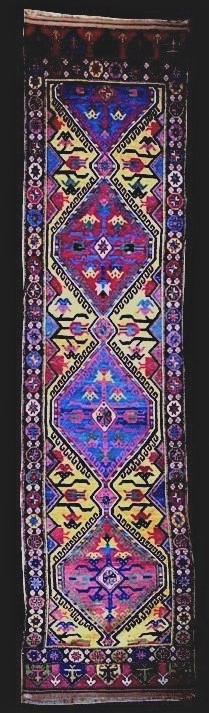
BELOW: Central Anatolia, Karapinar, c. 1800-50. SOLD
Large octagons of this Holbein type are signature elements in earlier pile weavings from central Anatolia. Rugs of this type were often woven as long runners. This example probably had four medallions originally.
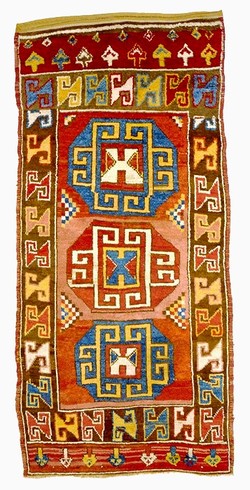
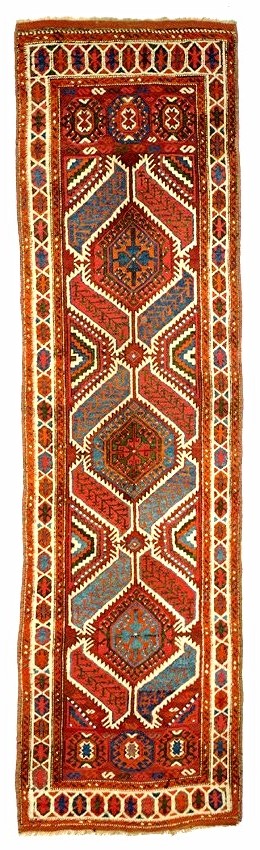
BELOW: Central Anatolia, Karapinar, c 1850. With 'saz' leaf design.
The saz leaf was one of the primary elements in early Ottoman art. Here it is stylized into a more angular form, with a branch of hyacinth blossoms superimposed upon each leaf. The long silky wool has much luster and indicates a weaving center in the Gelveri-Karapinar region.
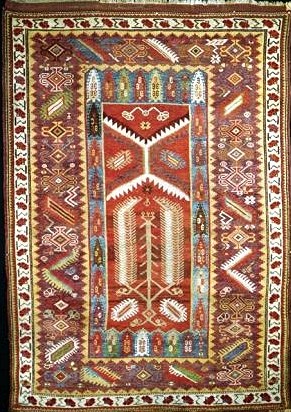
BELOW: S.W. Anatolia, Milas Prayer Rug, c. 1800-50. SOLD
BELOW: Central Anatolia, Aksaray, 1750-1800.
The copper red dye and long staple lustrous wool is distinctive in a specific group of rug attributed to Aksaray, as are the cross devices seen in the border and inside the medallions. Other types were made in the environs with completely different characteristics. Note the small areas of aubergine dye. Octagonal reserves are formed by hooked, triangular brackets and within each are bold Crivelli-type medallions, one rendered in clear pale blue and the other in yellow-green. Each medallion centers a large, archaic Turkic kaikalik motif. Along the bottom is a panel of stepped devices in a kufesque style. A fragment, consisting of the top half of an almost identical rug, identified as Aksaray, 18th century, was with Mehmet Cetinkaya in Istanbul in 2007. Another very similar complete rug, with the same copper red ground and two large blue-green Crivelli medallions, but with a calyx and serrated leaf meander border, was exhibited by Franz Sailer in the Perugia Carpet Fair in 1997: ANTICHI ARTI TESSILI. It is published in the catalogue, p 68, and attributed to "Aksaray, 17th century."
.jpg)
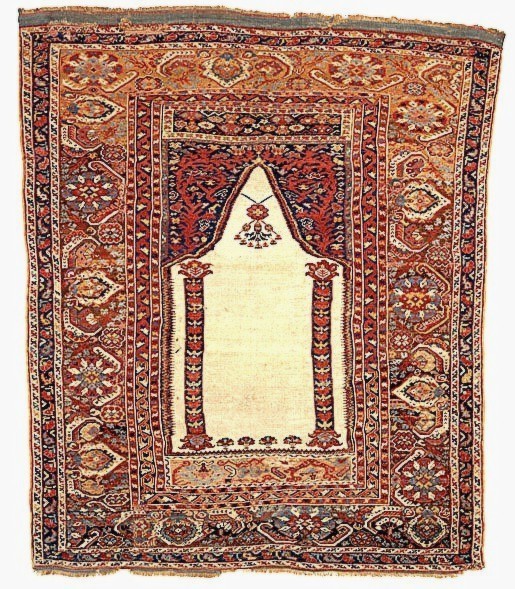
BELOW: This small prayer rug, 4.10x3.10 feet, was woven in the late 17th century. Another 17th century example with the rare white mihrab is in the Iparmuveszeti Museum in Budapest, and others are in Transylvania where they were imported from Anatiolia in the 17th and 18th centuries for use in Saxon churches. Many sources identify this design as being from the Gordes region of Turkey. And indeed many carpets were made there with this design. However, the weaving structure and wide range of dyes in this piece, including an oxidized dark brown not normally seen in Gordes rugs, indicate a center of weaving more likely in the Ushak region, near Gordes. Many rugs from Ushak were exported to Transylvania and this is likely one of them. Published and exhibited: Prayer Rugs from Private Collections, plate 3, p. 9, The Textile Museum, Washington, DC, 1974.
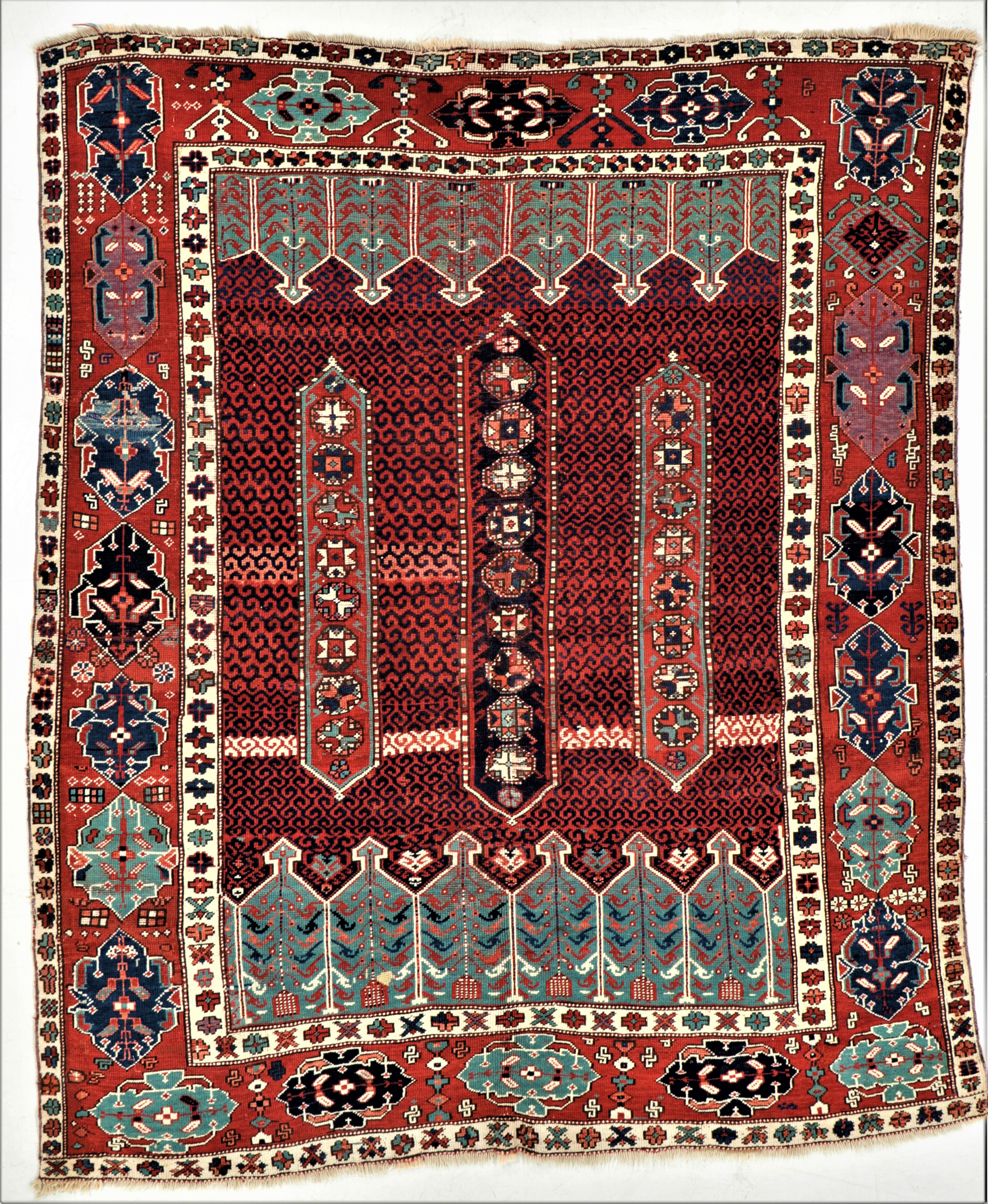
BELOW: Woven in the first half of the 19th century, the design of three elements in the central field is derived from triple-arch prayer rugs that were made from the late 16th century. Examples from ateliers in the Ottoman court show these as graceful rounded arches, while village and regional workshops produced angular stylizations. In this village rug from northwest Anatolia, the three floating motifs are actually reflections of three angular arch forms with all references to supporting architectural columns being removed. They sit on a field filled with an elaborate pattern of reciprocal hooks. The palette recalls weaving from the Balikesir region. Some have suggested that Yuncu or Karakecili weavers wove this rug. The border displays large angular cartouches that are seen in some Transylvanian rugs of the late 17th-early 18th century. They contain a lovely aubergine dye that is an unexpected surprise, as it the attractive teal blue-green in the top and bottom panels. I have seen this distinctive combination of colors on only one or two other Anatolian carpets from this period and each one has been from this regional design group. This particular rug was formerly in the private collection of Philadelphian John D. McIlhenny, whose family donated many extraordinary Classical period carpets to the Philadelphia Museum of Art.
BELOW: A square-format prayer rug, about 48 x 48 inches in size, shows pairs of mulitcolored hands on each side of ascending stepped arches. This pattern is most often found on flatwoven rugs made in the brocaded jijim technique. In this piece, probably made in the Karaman region of central Anatolia in the second half of the 19th century, the long-staple knotted wool pile is thick and many rows of dark brown undyed wefts are inserted between each row of knots. SOLD